

We Are All In A Prison...
No, not just the existential hellscape that is the world at war, pedophile rings and unprecedented heat indexes and drought. One that we all construct for ourselves. The good news is, we can get out.

The topic I find most compelling to explore, analyze, and articulate concerns the architecture of the mind. It is also the subject, I believe, that holds the greatest utility for you, my readers. As I navigate my own secular existence beyond linguistic or conceptual frameworks, I will, for the sake of clarity, employ the term “spirituality,” despite its limitations and the semantic baggage it carries. My objective is to present insights and perspectives that may serve as catalysts for deeper contemplation and critical engagement. More precisely, the intellectual and existential domain I am most engrossed in is that of eudaimonia—a term originating in ancient Greek philosophy, meaning “good spirit,” which has evolved in contemporary discourse to encompass human flourishing, well-being, and the realization of one’s highest potential.
So let’s not bury the lede: what the hell does it mean to actually live well? Not in the Instagram sense. Not in the “look at my meticulously arranged charcuterie board” sense. Not even in the “I have a stable job, a respectable retirement plan, and a dog who knows three tricks” sense. I mean capital-L Living. I mean waking up every day with the sense that you are moving toward something worth moving toward. I mean, being on fire with purpose instead of quietly burning out on distraction and dopamine loops.
To lead a eudaimonic life is to pursue fulfillment by cultivating meaning and purpose. This trajectory stands in direct opposition to the hedonic paradigm—a mode of existence largely propagated by capitalist ideologies—which equates happiness with the accumulation of material wealth and the pursuit of transient pleasures. Crucially, eudaimonia is not predicated on the eradication of pain but rather on the manner in which one engages with suffering. As Haruki Murakami aptly observes, “Pain is inevitable; suffering is optional.”
Which brings us to an arresting declaration from the Armenian philosopher and mystic G.I. Gurdjieff: “You are in prison. If you wish to get out of prison, the first thing you must do is realize that you are in prison. If you think you are free, you can’t escape.” Stop. Read that again. Let it sink in. It’s one of those statements that lands like a gut punch wrapped in an epiphany. It stings because it’s true.
Let’s break it down.
First premise: “You are in prison.” No, not literally. I assume if you’re reading this, you’re not currently tapping away on contraband internet access from a maximum-security cellblock. But prison? Oh, you’re in one. We all are. It’s just that our bars are made of narratives, biases, fears, and unchecked assumptions. And the worst part? Most of us don’t even know we’re locked up.
Human consciousness oscillates between two states: directed, purposeful engagement and unstructured, involuntary mental activity. When we’re locked into the first—when our attention is fully harnessed toward something that matters—we achieve feats of creativity, innovation, and deep connection. Think about the last time you got so lost in writing, coding, painting, debating, or even cooking that the world outside of that activity disappeared. That’s called flow. Mihaly Csikszentmihalyi (say that three times fast) describes flow as the optimal experience in which action and awareness merge, the self dissolves, and life just clicks.
But outside of that? We’re stuck in loops. Reciting personal grievances, regretting past mistakes, drafting future arguments we’ll never have. We scroll mindlessly. We react rather than act. And this? This is the prison Gurdjieff is talking about. It’s a self-imposed sentence, reinforced by years of unchecked conditioning, unconscious habit, and systemic distractions designed to keep us comfortably numb.
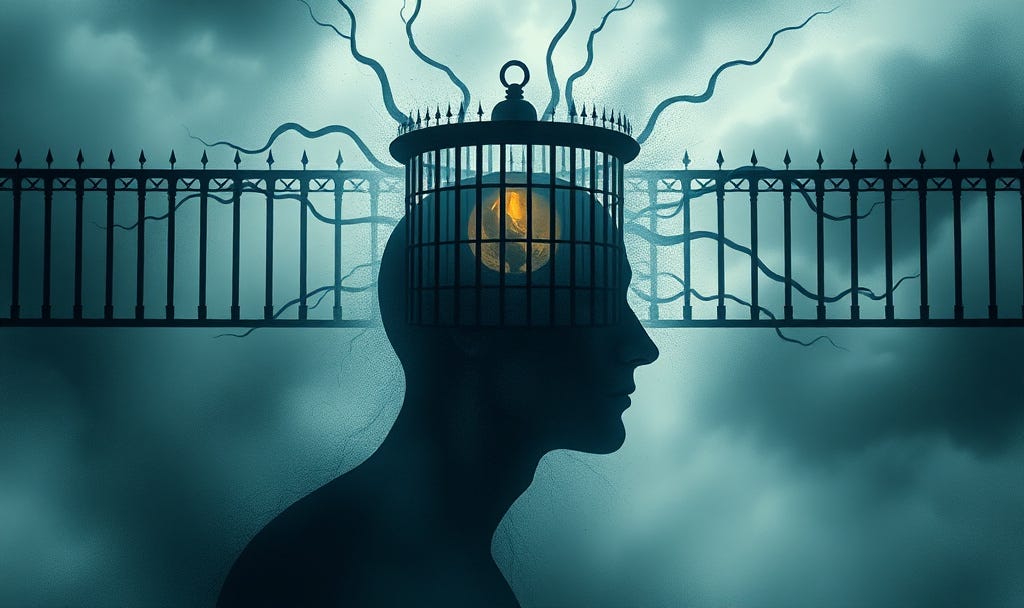
Now, here’s where it gets real: “If you wish to get out of prison, the first thing you must do is realize that you are in prison.” That moment—the realization—is the hinge on which change swings. It’s the moment the fish realizes it’s swimming in water. Throughout philosophical and spiritual traditions, from Buddhist mindfulness to existentialist thought, awareness is positioned as the first step toward liberation. Before you can fix the problem, you have to see the problem. Before you can escape the cage, you have to know you’re in one.
But, and here’s the kicker: “If you think you are free, you can’t escape.” This is the part that really messes with people. It’s the part that makes you uncomfortable at dinner parties when someone starts spouting off about how they’ve got it all figured out. Because here’s the thing—the more convinced you are that you’re above all this, that you see the matrix, that you’re free from delusion and conditioning? The deeper in the prison you actually are.
Liberation isn’t about acquiring something external; it’s about stripping away the illusions that keep you stuck. The work of dismantling the prison isn’t glamorous. It doesn’t come with a TED Talk and a book deal. It’s messy. It’s hard. It involves examining the stories you tell yourself, questioning the habits that shape you, and embracing a level of discomfort that most people spend their entire lives avoiding.
And here’s where it gets interesting: this isn’t a solo mission. The pursuit of eudaimonia is not a monastic endeavor where you sit in a cave and ponder the mysteries of life. It necessitates engagement. It requires dialogue. The ancient Greeks knew this, which is why Socratic questioning was the backbone of their philosophical tradition. The Buddhists knew this, which is why the sangha—the community—is essential to the path of awakening. Viktor Frankl, in Man’s Search for Meaning, understood this too: even in the face of unimaginable suffering, we define meaning through our choices, our interactions, our commitments.
So where does that leave us? Right here. Right now. Staring at the prison walls with the growing realization that they are, and always have been, of our own making.
Gurdjieff’s aphorism doesn’t end with a neat resolution, because real life doesn’t either. But what it does offer is an opening, a provocation, an invitation. The keys to the cell have been in your pocket the whole time. The question is: what are you going to do with them?
Because the door; It’s already unlocked.